


Crafting The Future
Rethinking what buildings—and materials—can be.
TEGULA
Principal Investigator: Dr. Laia Mogas-Soldevila.
Project Leads: Eda Begum Birol, Bhavana Priya Balasubramanian, Yasaman Amirzehni (equal contribution).
Production: Burcu Gocen, Aaron Dorand, Qianni Wang, Abby Weinstein, Sara Asa, Amir Motavaselian, Bowen Qin, Yuanyi Cen.
TEGULA series is custom designed for the CCA Pioneering Biomaterials Exhibit. It reflects on the capacity of matter to map and mediate environmental forces inside and outside of buildings through biochemical design in architecture. Sustainable TEGULA composites biodegrade at end-of-life and are in ongoing development for structural robustness towards matching traditional cements (Sand TEGULA), fiberboard (Cane TEGULA) and stone slab (Food TEGULA). They are bound by natural gums, braced by multi-length fibers from flax and fruit skin, and stiffened with minerals of silica and calcium.
Programmed interactions are carried in printed inks on top of TEGULA tiles and (1) change the aroma of indoor air with toxin-free compounds, (2) respond to rising temperature with color, and (3) track ultraviolet radiation from sunlight. Color and scent are the means by which interaction is validated, but benefits of these tiles go beyond signaling. They promote human health by using only biocompatible materials, enhance climate change awareness by connecting matter to environmental variation, signal building pathologies and health threats without use of mechanical devices, and push forward a biomaterials era that is aesthetically surprising and functionally robust.


Ecolitracy Workshop
Principal Investigator: Dr. Laia Mogas-Soldevila.
Project Leads: Team: Lead Researchers Bhavana Priya Balasubramanian & Yasaman Amirzehni (co-authors) and support class teachers Innocent & Oertling
Partners: St Peter’s School SPS, Mouhamed Mboup (Executive Chef at Penn Dining), Elise Dudley (Regional Sustainability & Food Edu at Bon Apetit).
As part of a broader mission to make biomaterial innovation accessible to the public, we collaborated with a local school to explore food chain circularity through hands-on design. We collected unavoidable food waste, including fruit peels from Penn Dining and eggshell byproducts from industrial poultry production, and processed them into functional composite materials.
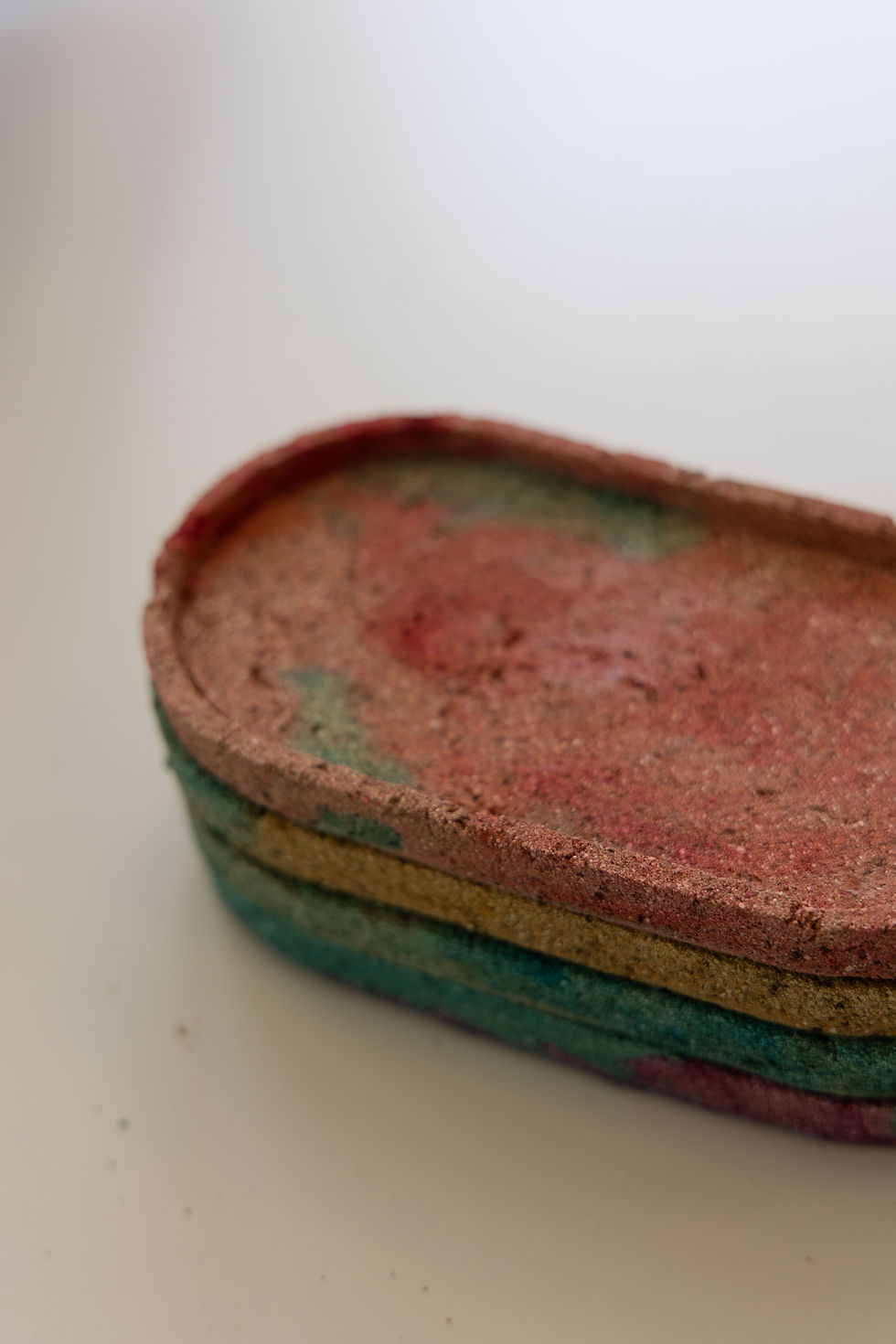
Timed with the arrival of newly hatched chicks in the classroom, the workshop introduced a mini-curriculum on food waste, landfill impact, and material potential. Over the course of the session, 21 students and their teachers engaged in crafting small ceramic-like trays using composites made from powdered banana, citrus, and melon peels, crushed eggshells, and water-based binders.
These student-made objects echoed the lab's recent “Eggregate” bio-receptive cladding research, offering an accessible and tactile way to understand circular systems and sustainable design thinking.
EGGREGATE
Principal Investigator: Dr. Laia Mogas-Soldevila.
Project Leads: Bhavana Priya Balasubramanian, Yasaman Amirzehni (equal contribution)
Eggregate is an experimental architectural project that integrates food waste valorization, material-driven computation, and ambient-condition extrusion printing to develop a catalog of multifunctional biocomposites aimed at enhancing urban climate resilience. The project explores how geometry and chemistry can be optimized together to respond to five key environmental forces.By repurposing unavoidable food waste, specifically the 14.8% of post-consumer restaurant waste that typically emits greenhouse gases in landfills, Eggregate transforms discarded matter into a tool for environmental and economic circularity.
Situated at the intersection of waste-based material innovation, distributed sensing, and ecologically responsive architecture, Eggregate contributes to emerging conversations in sustainable design. It aligns with recent global research into agricultural and maricultural waste reuse, and materials with bio-reactive, bioreceptive, and photosynthetic capabilities, offering new paths forward for adaptive, low-impact urban infrastructure.


Bio-Totem Tiles
Principal Investigator: Dr. Laia Mogas-Soldevila.
Project Leads: Yasaman Amirzehni, Bhavana Priya Balasubramanian
This project reimagines architectural tiles as vessels of memory and connection. Each small cylindrical piece is designed to hold a written memory, image, or personal artifact, coming together to form a collective “wall of belongings” that reflects the identities and shared histories of a community.
What makes these pieces truly unique is not just their purpose, but their materiality. Made entirely from 100% food waste, the tiles are composed of natural byproducts, transformed through low-energy, non-toxic processes into strong, fire-resistant, and biodegradable components. The fabrication process is simple and accessible, requiring minimal energy and producing no harm to the environment, before, during, or after use.
These pieces are not only sustainable, but sensory-rich: their earthy tones and organic textures blend seamlessly into natural and built environments, while their subtle, plant-like scent enhances the spaces they inhabit. The material can be shaped, sanded, reused, or safely returned to the earth, leaving no trace and offering complete circularity.
More than just tiles, they are quiet storytellers, modular markers of memory that bring warmth, nature, and belonging to the surfaces we live with.
Research Profile
I am an architectural designer and researcher with a deep interest in discovering and developing innovative materials that can reshape how we build, fabricate, and live, without compromising our environment. My work is rooted in a curiosity for how overlooked or unexpected substances around us can be reimagined into functional, construction-ready systems that support sustainability and resilience.
I'm particularly passionate about exploring how material systems can reduce the environmental impact of architecture while still enabling expressive and high-performance design. This includes experimenting with fabrication techniques, understanding material behavior, and applying that knowledge across scales, from small objects to full-scale architectural components.
Working with DumoLab has given me the unique opportunity to engage in hands-on material research, access state-of-the-art labs, and test new material blends through methods like extrusion, casting, and 3D printing. Through these explorations, I've conducted various performance evaluations to improve material strength, responsiveness, and ecological viability.
I’m constantly drawn to the intersection of design, fabrication, and environmental consciousness, and I’m always open to new ideas, collaborations, and experimental projects that push boundaries and ask: What else can this become?
