


Fairmont Boathouse
Summer 2024
Philadelphia, PA, US

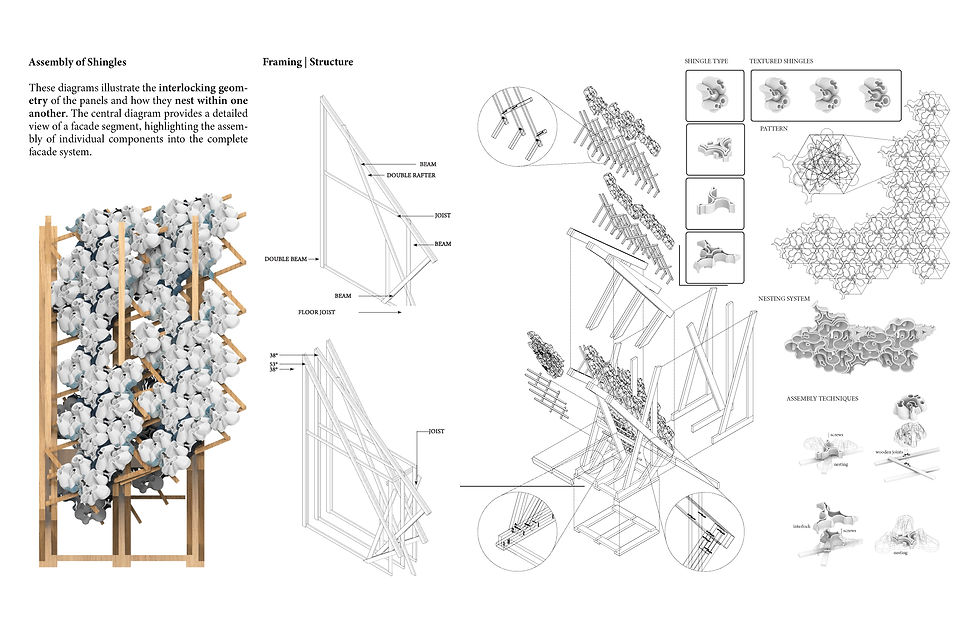
This project focused on developing a facade system for a boathouse. The final deliverable was a full-scale mock-up measuring 10 by 4 feet, representing a portion of the building envelope. The wooden structure consisted of two layers: a primary structural frame and a secondary frame to support custom shingles. These shingles were 3D printed from clay using robotic arms and then glazed to ensure water resistance and achieve the desired aesthetic finish.
Rethinking Rainscreens
Climate-Conscious Cladding merges robotic fabrication with innovative design to redefine the performance and aesthetics of rainscreen systems.
As seen in the axonometric drawing of the boathouse structure, the building is composed of two A-frame forms, each cut in half and separated by a central gap. This gap is intentionally designed to bring natural light into the core of the space. The A-frames are extruded along two intersecting curves, a move inspired by traditional boathouse layouts in Philadelphia, where boats are typically stored in the center with circulation paths along the sides. This extrusion creates a central corridor for boat storage, with shelving systems in the middle and walkways for users along both edges, maintaining functionality while enhancing spatial experience.


Prototype Axnometric
The selected façade section for the prototype features an angled surface, achieved by combining two flat planes to create a low-resolution curved form. These overlapping surfaces function as rainscreens, effectively directing water away and preventing infiltration. A third layer, supported by a separate framing system beneath, acts as an additional protective barrier against moisture.


This section illustrates two intersecting A-frames of varying sizes and heights, forming a central gap that allows natural light to enter the space. The roof seamlessly extends into the walls, incorporating a carefully detailed rainscreen system. Rainwater is managed in two stages: first, it is collected by the upper layer, then by a secondary layer below, which channels it through a rear glass screen and directs it safely to the ground.
Fairmount Park, Philadelphia, PA
